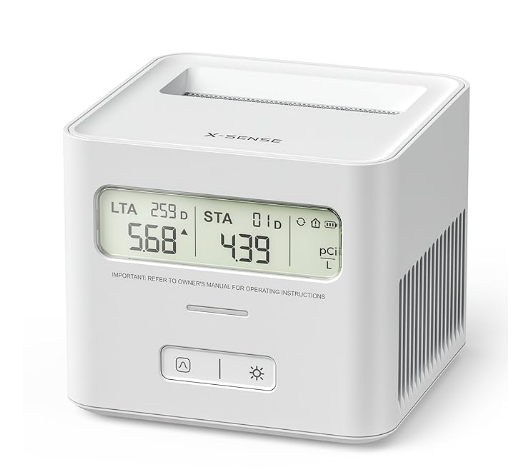
There’s a radon monitor sitting on a shelf in my basement. I bought it on a whim — Ohio is a high-radon state, I’d been meaning to test for years, and a continuous digital unit meant no lab fees and nothing to mail in. What I didn’t expect was how much I’d learn from simply watching the number move.
This post is part of what I picked up from that, and part of what I see on the transaction side of my work. If you own a home in Southwest Ohio — or you’re about to buy one — radon is worth twenty minutes of your attention.
The local numbers
Ohio’s soil and bedrock are uranium-rich, and much of the state sits on permeable glacial deposits that let gas migrate easily. Most of Ohio — Hamilton County included — is classified EPA Radon Zone 1, meaning predicted indoor average levels above 4.0 pCi/L. Warren and Butler Counties, where Mason and West Chester sit, are in the same geological picture.
The Indoor Environments Association’s 2026 Ohio Radon Report Card analyzed 98,840 tests across the state and found roughly 52% came back at or above the EPA action level of 4.0 pCi/L. ODH has long advised that about half of Ohio homes exceed the threshold.
💡 Three assumptions worth dropping
1. “New construction is safer.” Not necessarily. Tighter, better-sealed homes can hold radon in longer.
2. “My neighbor tested low, so I’m fine.” Two houses on the same street can read completely differently — it depends on soil, foundation condition, and how the house moves air.
3. “No basement, no problem.” Slab-on-grade ranches and crawl space homes test high too.
In practice, I’ve seen 2 pCi/L and 12 pCi/L within the same subdivision. Your number is your number. That’s exactly why ODH recommends testing every home regardless of location or foundation type.
What a Continuous Monitor Showed Me That a Kit Couldn’t
A one-time test kit gives you a single snapshot. A continuous monitor gives you a running picture, and the difference turned out to matter more than I assumed it would.
Mine displays a short-term average and a long-term average side by side, and those two numbers rarely match. Radon moves. It runs higher when the house is closed up. It climbs in winter, when the furnace is running and the house is effectively pulling air up out of the ground. It shifts after heavy rain and after changes in barometric pressure.
A test you ran in July tells you very little about February.
That seasonal swing is the single most useful thing I’ve learned, and it’s invisible to a two-day kit taken once. It also means you can actually verify whether something worked — better basement ventilation, a sealed sump pit, a mitigation system. The number either comes down or it doesn’t.
How Radon Shows Up in an Ohio Transaction
If you’re buying
Ohio does not require sellers to test or mitigate. Sellers are required to disclose known radon test results and any existing mitigation system on the Residential Property Disclosure Form.
In practice, radon testing is added onto the home inspection during your inspection period, with results back in about 48 hours. If levels come in at or above 4.0 pCi/L, that becomes a legitimate item in your inspection response — asking the seller to install a system or credit the cost is common in this market, not unusual.
If you’re selling
Testing before you list is almost always the better play. A surprise result during the inspection period turns a negotiation into damage control, and you lose the ability to shop mitigation contractors on your own timeline. If you already have a system, gather the installation paperwork and the post-mitigation test result — buyers read that as diligence.
⚠ Before you write an offer on a home with a system
A listing that says “radon mitigation system” is telling you the system exists, not that it works. Confirm three things: installation year, whether the fan is actually running, and the date and result of the most recent test.
None of this is complicated once you’ve seen it a few times. It’s just unfamiliar the first time through, and unfamiliar things tend to get skipped — which is the whole reason I wrote this.